Open-World Level Design Based on Real-World Cities - Week 1 Blog
This is my independent study project for a semester in Carnegie Mellon University’s Entertainment Technology Center program. It will mainly focus on the design principles of “real-world” city levels.
Week 1 Goal:
- Select open-world games for study;
- Define analysis framework and research focus.
“Real-World” City Levels
In this independent study project, I will focus on the design principles of “real-world” city levels, including how to translate real urban structures into playable game spaces, how to guide player exploration within complex city layouts, and how to balance realism with gameplay needs.
Level example: Los Santos in Grand Theft Auto V, based on Los Angeles, California and its greater metropolitan area.
Target Games
Due to the rapid development of game design in the past few years, modern games will be my first choice.
- Grand Theft Auto V: Los Santos, based on Los Angeles, California and its greater metropolitan area.
- Marvel’s Spider-Man 2: New York City, based on New York City, New York State.
- Watch_Dogs® 2: San Francisco, based on San Francisco, California.
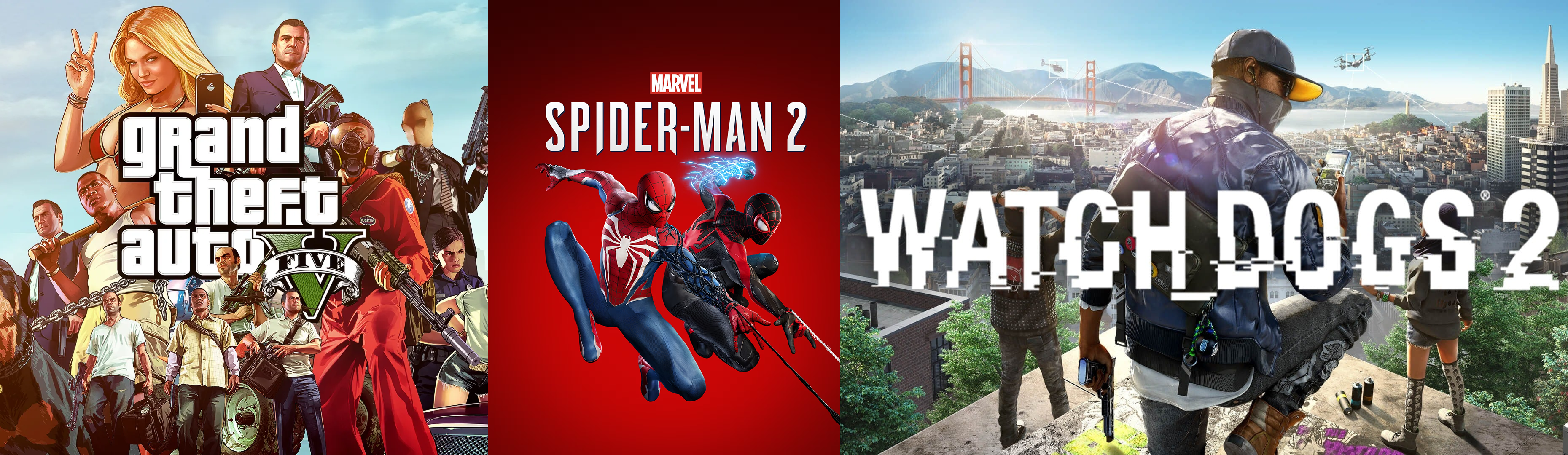
Other games will also be referenced as supporting examples, such as Cyberpunk 2077 and Fallout: New Vegas, among others.
Analysis Framework & Research Focus
- City Structure & Spatial Abstraction: How real-world city elements (paths, edges, districts, nodes, landmarks) are simplified, exaggerated, or reorganized to support gameplay flow and player comprehension.
- Scale, Density, and Traversal: How city scale and density are adjusted to balance realism with traversal speed, traversal mechanics, and moment-to-moment engagement.
- Exploration Flow & Player Guidance: How level designers guide player movement and exploration in dense urban environments through landmark placement, sightlines, road hierarchy, vertical traversal routes, and environmental cues, while maintaining a sense of player freedom.